Large-scale job sites require strict spatial management to prevent logistical gridlock. The 30-yard dumpster measures 22 feet long, 8 feet wide, and 6 feet tall, providing roughly 30 cubic yards of container capacity,…
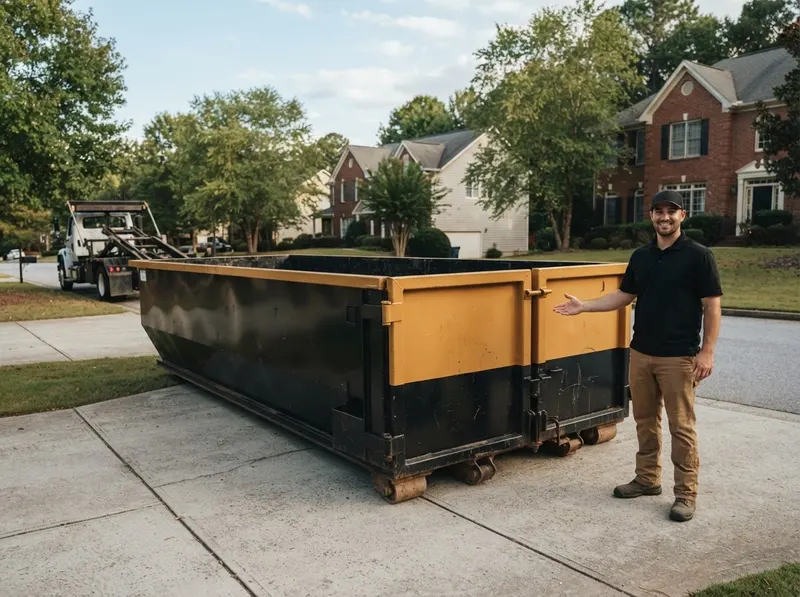
Large-scale job sites require strict spatial management to prevent logistical gridlock. The 30-yard dumpster measures 22 feet long, 8 feet wide, and 6 feet tall, providing roughly 30 cubic yards of container capacity, which equals roughly 9 to 12 standard pickup truck beds. It fits multi-room interior gut jobs, extensive framing refits, commercial tenant buildouts, and structural roof tear-offs. For lighter residential cleanouts or single-room tile removals, a 10-yard container ($595) or 20-yard container ($695) minimizes curb usage; however, underestimating debris mass risks mid-project operational shutdowns, double-handling framing timber, and incurring unnecessary swap-out logistics. Placing a 30-yard unit establishes continuous waste containment without exceeding property boundaries.
Navigating transport logistics in historic intown Atlanta requires direct planning. Street drops along tight municipal roadways in Inman Park, Virginia-Highland, Grant Park, and Cabbagetown require review against the City of Atlanta Department of Transportation right-of-way staging guidelines to avoid blocking thoroughfares. When staging on residential driveways near Buckhead, Collier Hills, or Midtown, trucks maneuver through canopy trees regulated by the City of Atlanta Arborist Division. Every deployment utilizes wood blocking beneath the roll-off steel wheels to protect finished concrete and asphalt from direct ground-bearing pressure.
Rigid waste management standards dictate sorting practices on urban projects. Hazardous components, chemical containers, and loose insulation must follow the protocols established by the U.S. Environmental Protection Agency hazardous waste management guidelines. In contrast, heavy non-hazardous structural mass is diverted through regional recycling facilities compliant with the Georgia Environmental Protection Division. Job managers orchestrating commercial refits near Ponce City Market or Old Fourth Ward must comply with the OSHA standard 1926.252 for disposal of waste materials to maintain clear exit corridors and perimeter fall protection during loading operations.
Disposal hauls exit central Fulton County transit arteries such as Interstate 85, Interstate 20, and the perimeter around Interstate 285 to licensed municipal waste hubs adhering to the Solid Waste Association of North America operational benchmarks. Sorting metal, timber, and masonry aligns with green building targets governed by the U.S. Green Building Council LEED certification framework. Recyclable bulk materials, mechanical systems, and residential appliances adhere to the Earth911 recycling directory standards, while commercial construction safety remains bound by National Safety Council job site guidelines and transport rules codified by the Federal Motor Carrier Safety Administration. Dispatch can be reached directly at (470) 750-7065.
Every job gets a firm, written price after a free on-site visit.
For standards, safe disposal, and service guidance on DUMPSTER in Atlanta, GA, useful references include U.S. EPA, EPA, EPA, OSHA, Earth911, and Google Maps. General consumer and small-business resources are available from USA.gov, Better Business Bureau, FTC Consumer Advice, U.S. Small Business Administration, and Ready.gov.
Tell us about your 30-yard dumpster job in Atlanta and we'll send a clear, written quote, usually the same day.
 LoadCraft Debris Services