Organic land management requires strict volumetric and weight discipline to prevent site bottlenecks. When clearing heavy storm debris in Collier Hills or trimming root systems around historic bungalows in Inman Park…
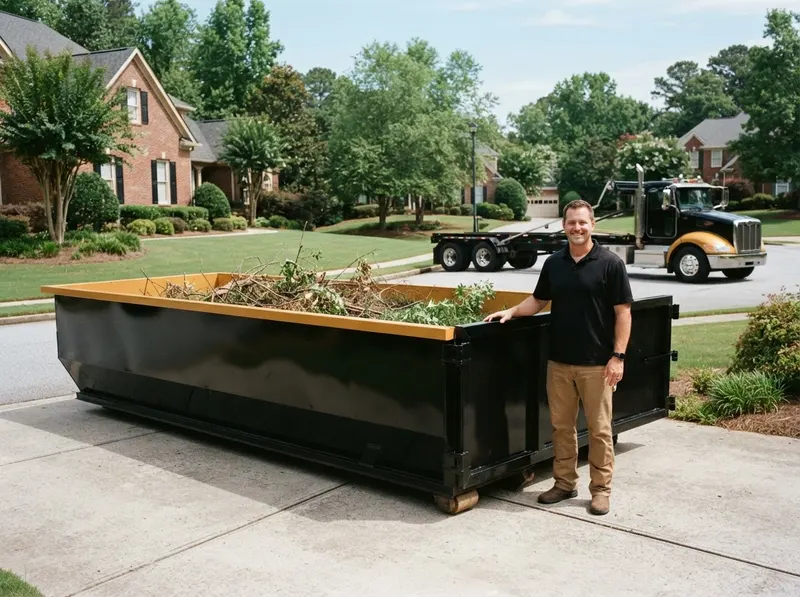
Organic land management requires strict volumetric and weight discipline to prevent site bottlenecks. When clearing heavy storm debris in Collier Hills or trimming root systems around historic bungalows in Inman Park and Grant Park, separating vegetative waste from standard municipal refuse keeps projects compliant with the Georgia Environmental Protection Division. Mixed-waste loads often incur high municipal sorting fees, whereas clean vegetative debris qualifies for processing at regional composting facilities. LoadCraft Debris Services delivers heavy-gauge roll-off containers staged on protective timber blocking to preserve finished concrete drives along Virginia-Highland and Buckhead estates. The trade-off between container sizes centers on material density versus physical access: dense root balls and moist topsoil quickly approach gross axle weight thresholds, making lower-profile 10-yard or 15-yard bins safer for narrow urban driveways, while sprawling branch mass from lot clearings in Old Fourth Ward and Kirkwood demands high-walled 30-yard or 40-yard containers.
Site positioning dictates whether an operational staging plan succeeds. Dropping a commercial container on city thoroughfares or tight rights-of-way near Piedmont Park or Cabbagetown requires compliance with the Atlanta Department of Transportation street-use guidelines. Standard deployments avoid street permits entirely by utilizing private driveways, stabilized turf, or designated gravel access lanes. Ground impact mitigation remains an absolute operational requirement; dual rubber tires and seasoned wood runners distribute bin weight to avoid crushing hidden sewer laterals or subterranean utilities marked by Georgia 811. For expansive residential lot clearings near West End and Midtown commercial fringes, staged container exchanges ensure your tree crews never stop feeding chippers or wait on empty boxes, supporting sustained production alongside standards from the Tree Care Industry Association.
Material handling limits must be respected during mechanical loading. Clean green waste streams exclude non-biodegradable debris such as treated lumber, asphalt, hazardous liquids, or plastics regulated by the US Environmental Protection Agency. Felling and clearing operations executed near commercial parcels or high-density corridors like the Atlanta BeltLine Eastside Trail and Ponce City Market often involve heavy forestry machinery, requiring compliance with Occupational Safety and Health Administration jobsite clearance rules. For timber disposal tracking, sustainable forestry guidelines from the Georgia Forestry Commission emphasize processing vegetative refuse through secondary markets rather than municipal landfills. Stumps exceeding standard diameter limits should be sectioned before placement to ensure level top lines that meet transit containment requirements supervised by the US Department of Transportation. Diverting pure wood components aligns with processing metrics from the US Composting Council and broader material reuse models documented by the Earth911 Directory.
Every job gets a firm, written price after a free on-site visit.
For standards, safe disposal, and service guidance on DUMPSTER in Atlanta, GA, useful references include U.S. EPA, EPA, EPA, OSHA, Earth911, and Google Maps. General consumer and small-business resources are available from USA.gov, Better Business Bureau, FTC Consumer Advice, U.S. Small Business Administration, and Ready.gov.
Tell us about your yard waste & organic land clearing dumpsters job in Atlanta and we'll send a clear, written quote, usually the same day.
 LoadCraft Debris Services