A 40-yard roll-off container delivers the maximum volumetric capacity permitted for street-legal transport across Fulton County , providing 40 cubic yards of storage. This footprint accommodates commercial gut-rehabs…
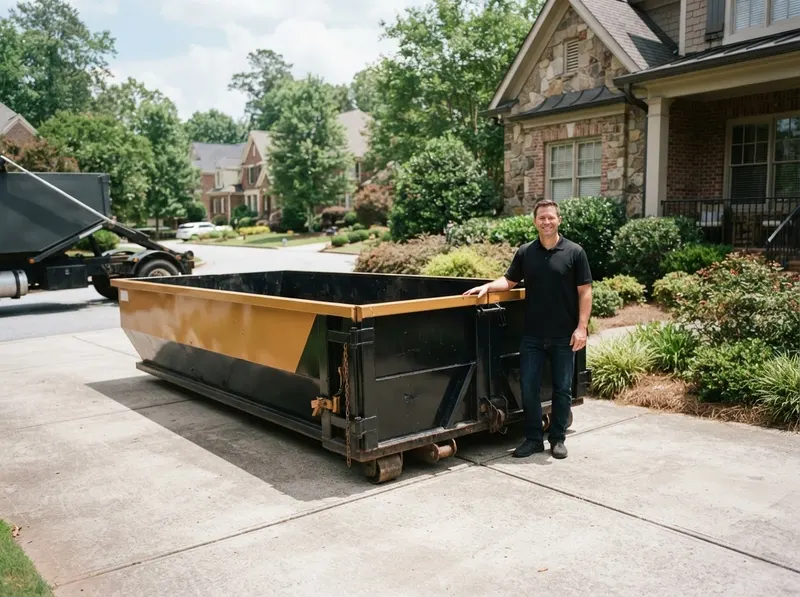
A 40-yard roll-off container delivers the maximum volumetric capacity permitted for street-legal transport across Fulton County, providing 40 cubic yards of storage. This footprint accommodates commercial gut-rehabs along Peachtree Road in Buckhead, multi-floor historic renovations in Inman Park, and structural refits near Ponce City Market. A 40-yard unit features 8-foot-tall steel side walls and full-swing rear doors, allowing continuous wheelbarrow loading for bulky structural debris. Project managers running active framing or commercial retrofits rely on this size to avoid the job site shutdowns caused by undersized, overflowing bins.
Selecting container capacity requires balancing square-footage volume against disposal weight limits enforced under U.S. Department of Transportation gross vehicle weight ratings. A 40-yard dumpster is engineered specifically for high-volume, low-to-medium-density waste such as dimensional lumber, drywall panels, carpet, and packaging trash. If a project involves heavy inert aggregates like poured concrete, wet brick, or subsoil, choosing a smaller 10-yard container prevents severe transport overage penalties, because road limits cap maximum legal hauls regardless of remaining container volume. Deploying a 40-yard container in dense urban corridors such as Midtown, Old Fourth Ward, or Virginia-Highland requires evaluating physical footprint trade-offs: the delivery truck requires 60 feet of straight-line clearance and 22 feet of overhead vertical space, avoiding low-hanging magnolia canopies and utility drops.
Placement logistics on residential drives in Grant Park, Cabbagetown, or Kirkwood demand strict structural precautions to prevent concrete cracking or asphalt impressions. The gross loaded weight of an active container can reach thousands of pounds, requiring heavy hardwood displacement planks under the steel rollers to isolate the driveway from point-load damage. In street-drop locations governed by the City of Atlanta Department of Transportation, public right-of-way staging may require municipal permits if the unit blocks travel lanes or meter spots. Disposal sorting must adhere strictly to environmental guidelines established by the Georgia Environmental Protection Division, precluding wet chemical waste, petroleum products, and unbonded materials. Direct operational scheduling coordinates delivery times directly to match crane drops, interior gut deadlines, or framing inspections across West End and Collier Hills.
Every job gets a firm, written price after a free on-site visit.
For standards, safe disposal, and service guidance on DUMPSTER in Atlanta, GA, useful references include U.S. EPA, EPA, EPA, OSHA, Earth911, and Google Maps. General consumer and small-business resources are available from USA.gov, Better Business Bureau, FTC Consumer Advice, U.S. Small Business Administration, and Ready.gov.
Tell us about your 40-yard dumpster job in Atlanta and we'll send a clear, written quote, usually the same day.
 LoadCraft Debris Services